Showing posts with label Nuclear. Show all posts

Tuesday, May 3, 2016

34. What is an Advanced Reactor

Early today, I saw a response to a tweet from David Roberts (@drvox on Twitter) that had posed a good question.

The term "Advanced Reactors" definitely doesn't have a hard and fast definition, unfortunately. Also, there are the Generation I, II, III, III+, and IV terms thrown around for different generations of reactors that possess different features in terms of technological advancements, fuel utilization, economics, and safety features.

These Reactor Generation designations are not incredibly well-defined, much less well-defines than the 300 MWe cut-off under which a reactor would be considered an SMR (small, modular or small or medium reactor).


Are Britain's gas-cooled reactors designed in the 1950's Gen I or Gen II?

Is it possible to have a water-cooled reactor that is Gen IV......even a super critical water-cooled reactor (according to the title of this .pdf, apparently yes for the super critical concept)? Or is substantial fuel breeding a prerequisite for "qualifying" as Gen IV?

Would the thorium breeding for Shippingport's final fuel load (additional writeup from Rod Adams) make that obviously Gen I reactor be closer to being a Gen III for that fuel cycle, since fuel was bred.........with the lack of "more modern" technology (lack of passive safety features.........or maybe Shippingport did have passive safety features?) and being literally the FOAK land-based PWR preventing it from being Gen IV (or even II or III)?


I chimed in with my present understanding (which has been painted by a few recent happenings).
Then I mentioned a few of the happenings.
As was mentioned in my Twitter response, I feel like the following 3 "advanced reactor" items are referring to non-light water cooled reactors (counting the 2 bills as a 1 of the 3). The Advanced Reactor Design Criteria (presently under a public comment period) are certainly explicitly geared that direction. The Nuclear Innovation Alliance also recommendations also seem to be geared that direction (with a big emphasis on how the licensing process relates to the confidence needed for investment capital to be risked).

The NRC's present licensing process is tailored to light water reactors (LWRs), and does not presently lend itself to licensing molten salt, molten salt-cooled/solid-fueled (like Per Peterson's "FHR"), gas-cooled, sodium-cooled, lead-cooled, etc. reactors. 

NRC comment period on Advanced Reactors:

Strategies for Advanced Reactor Licensing:

Nuclear Energy Regulatory Modernization Act:

Nuclear Utilization of Keynote Energy Policies Act (horrible bill name):
http://atomicinsights.com/house-energy-commerce-seeks-enable-advanced-nuclear-energy/

In conclusion, my thoughts are that although the Westinghouse AP1000 is a Gen III reactor and the A in its name is for "advanced", I would say that most of the recent discussion of "advanced reactors" is not referring to the AP1000 (or the APR1400 or any other iteration of a PWR or BWR) geared much more towards reactors designs other than light water-cooled reactors (LWRs, which includes pressurized and boiling water reactors [BWRs]) or CANDUs (which are cooled by heavy water). 

Tuesday, May 19, 2015

33. How to END Global Fossil Fuels Subsidies

A headline from May 18th from The Guardian really caught my eye.

Fossil Fuels Subsidised by $10 million a minute, IMF says (note the British spelling of subsidize)

In summary, the International Monetary Fund (IMF) has completed a study of global fossil fuel subsidies. They calculated a whopping $5.3 trillion worth of annual subsidies for fossil fuels. I have not yet had a chance to thoroughly read the study, and doubt that I will find time in the near future. 

These subsidy calculations include implicit impacts from both local air pollution (see: Beijing, China) as well as impacts purported to be the result of increased heat being trapped in the atmosphere due to the increase in the concentration of atmospheric CO2 that has been observed following the ever-increasing combustion if fossil fuels, with the combustion products (mostly CO2) being dumped more or less directly to the atmosphere. Most people shorten this to climate change, formerly known most often as anthropogenic global warming (AGW).

Note that this post is not meant to argue whether global warming or anthropogenic climate change exists, it is simply to lay out a simplistic plan that would eliminate, over a matter of roughly 2 to 3 decades, a great deal of the subsidies enjoyed presently by fossil fuels (which mostly freely release combustion products to the atmosphere).

The simple proposal (other than politically simple)
Most proposed carbon taxes I have seen over the years have suggested a tax of at least $25 dollars per ton. The article I linked above mentioned a projected cost of 42 pounds per tonne (roughly the same as a ton) of carbon dioxide emissions.
Aside: I should maybe be ashamed to admit that I never have bothered to research the rigor of whether these often-thrown out number are per ton of Carbon in the CO2 released or per ton of CO2, with the oxygen molecules included on the calculation. This is basically irrelevant for the discussion of my proposal here, other than being about a factor of about 3.66 off (3.66 = 44/12 : rough CO2 molecule atomic weight versus carbon atom atomic weight). End aside

Whichever method is typically used in the calculations for computing a carbon/CO2 tax, my proposal will involve instituting such a "carbon" tax in the U.S., but limiting the tax to only $10 per ton (of carbon or carbon dioxide). This cost is much lower than most carbon taxes that have been proposed (that I can recall). Of the revenues generated by this carbon tax, I propose that in the neighborhood of only $2-3 Billion per year for ONLY 5-10 years be allocated to help advance peaceful nuclear power. This level of spending will leave plenty of money leftover for other worthy causes, which I will leave for others to fight over. Despite this "relatively" modest amount dedicated to advancing peaceful nuclear energy, the amount would be enough to kickstart nuclear energy. Properly deployed funding within the U.S. would put the world on a course that can legitimately end the need for any future fossil fuel subsidies. This will eventually result in a reduction reduction global CO2 emissions and allow an increasing of the standard of living of people all across the globe.

For this reduction of CO2 emissions and increase of worldwide standard of living to occur, I would prefer to see the United States regain a top position in supplying nuclear power plants for export. The U.S.-produced designs must be capable of competing with Russian, South Korean, and Chinese plant designs, as those three nations are presently far-and-away leading the world in exporting ready-to-build nuclear power plants. I am afraid that without some fairly rapid policy shifts within the next 5 years, the U.S. will have fallen fully behind the 3 nations listed above, possibly with no hope of recovering.

2 Primary Uses of the Funds


1. Regulatory Funding Reform (combined with a shift toward Enabling rather than Disabling)

Of the $2-3 Billion annually to be allocated to advancing to U.S. peaceful nuclear power endeavors, $200 Million should go towards providing additional funding to the Nuclear Regulatory Commission (NRC), above and beyond the present $1 Billion budget, all but about 10% of which is provided directly from license-holder fees. The primary use of these new funds (greater than 60%) should be to fund hiring of new employees and training staff to support licensing of advanced reactor design and fuel cycle facility license applications.

In conjunction with this new increase of funding, the overall direction of the NRC should be ever so-slightly re-calibrated, more towards enabling than disabling, with NO CHANGE to its reason for being:  "The NRC was created as an independent agency by Congress in 1974 to ensure the safe use of radioactive materials for beneficial civilian purposes while protecting people and the environment."

2. D.O.E. Nuclear Innovation Fund

The funds wouldn't necessarily have to all go through the D.O.E., but more funding needs to be provided to some innovative nuclear power startups than the $452 Million over 6 years that the SMR program was allocating. While those funds should be useful, they are going to light water reactor designs, which are well-proven and probably a little less worthy of subsidizing than some advanced designs that could really advance the overall nuclear fuel cycle. These designs and concepts would not be limited only to reactor designs, but also to advanced fuel cycle facilities. 

Why Will It Work


Simple: Because E = mc^2  (E being energy, m being mass and c being the speed of light........and the speed of light is FAST, really really fast, and SQUARED; thus a tiny change in mass equates to a massive amount of energy)

If you don't understand why I provide such a short answer, PLEASE go read more about nuclear energy and energy density. Basically, nuclear power is a far superior energy source to any other alternative that has been commercially developed so far in terms of the combination of energy density, controllability, and overall environmental impacts.

Limiting the funding to no more than 10 years would make it slightly more palatable politically, although this proposal would be sure to have numerous vehement opponents who would stand to lose out in a true nuclear renaissance. The combination of several years of sustained funding, combined with slight regulatory recalibration would be sufficient to overcome the "coefficient of static friction" that is presently hindering the deployment of peaceful nuclear energy within and from the U.S. and enter a period facing only "rolling resistance" (kinetic friction). Kinetic friction is generally much less than static friction, so once nuclear power enters more of a kinetic friction regime, other sources of energy will be unable to beat it out in any properly-designed, fair market. The qualities that make nuclear energy a superior source of energy will cause it to win out in the markets it is suited for. I would expect that in this hypothetical future, that fossil fuel subsidies could be all but fully eliminated from the world within 25-30 years of the start of my proposed program.

Wednesday, October 15, 2014

32. New Blog Post coming soon (dormancy ending)

It has been far too long since I have written a new blog. For that, I apologize.

My upcoming post will feature a song from Shovels and Rope. 

If anyone is reading this or following this blog closely, a new posting will happen soon. Sorry to not write anything since April 2013. I can make no promises regarding posting frequency in the future. I recommend Rod Adams' Atomic Insights for regular pro-nuclear slanted postings.

Saturday, March 16, 2013

28. Nuclear Risks are Acceptable, YOLO

Up-front Warning, this post will include a humorous video courtesy of Andy Samberg's "The Lonely Island" (which also features Maroon 5's Adam Levine). Skip ahead and scroll down to watch that if you don't care all that much about reading how I tie it into Nuclear Power. Now, on to your completely irregularly-scheduled Entreprenuclear blogging.


Earlier this week, I read this excellent piece written by Dr. Robert Hargraves (author of Thorium: Energy Cheaper than Coal) regarding how opposition to nuclear power approaches superstition. There is no point in me re-hashing that post here, so just go read it.

HERE is an even bigger link to it. (note the interesting list of publications at the end that chose not to publish it)

On a very similar note, not too long ago on Forbes, this article from Jim Conca described how the risks of low-level radiation are so small that they get lost among all other background risk factors. I also recommend reading this article if you haven't yet and get a chance. 

Now for the embedded funny video, which I will then (hopefully sufficiently) relate to the gist of this posting, in case it is somehow non-obvious to anyone who might read this.


Oh, in case you're reading my blog somewhere that is not conducive to watching the video embedded above, I will describe it for you. The video is from the group The Lonely Island and features Maroon 5's Adam Levine (also one of the judges on "The Voice"). If you are familiar with The Lonely Island, their videos have often been featured on the highly popular show Saturday Night Live, often simply referred to as SNL. The song is titled YOLO, which stands for "You Only Live Once". The song and music video accomplish what I found to be an outstanding job of poking fun at the idea of people being excessively risk averse in stark contrast to the presently-popular "YOLO" mantra (the battle cry of a generation, per this song).

The song starts off with the lyric "This life is a precious gift, so don't get too crazy, it's not worth the risk." Lonely Island then takes this absurdity of risk aversion to the extreme by suggesting such things as you should pull out all your teeth to avoid biting your tongue and that you shouldn't go to loud clubs because it is bad for your ears. It suggests burying all your money in your backyard, never traveling anywhere by any mode of transportation, and wearing a titanium suit in case a piano might fall on you. Basically, nothing in life is 100% safe, and to actually live a life worth living, taking risks is an absolute necessity.

Most people probably wouldn't immediately think so, but fears of low-level radiation from nuclear power are every bit as outlandish as the risk aversion that The Lonely Island parodies in "YOLO". The reason that might not seem to be the case for many people is that people have been systematically taught over the course of decades to have outlandish fears of radiation (even at levels below detectable/discernible impacts). Here is a graphic from IDigUMining.com of the ACTUAL numbers for how safe various sources of energy are.

Risks from low-level radiation are minuscule (also sometimes spelled miniscule), to the extent that they get lost in the statistical noise. Risks of having insufficient energy are much, MUCH greater.

The total production capacity of the worldwide economy is limited by the amount of useful energy available to be used. To attempt to claim otherwise would be a losing battle. People currently living in poverty in the world could best be brought out of their poverty by having sufficient access to clean and reliable energy. Having more energy at a person's command gives them the opportunity to more access to clean water and to sufficient food. Energy also gives people sufficient freed up time doing more than merely surviving the day that they can become educated, and even pursue leisure activities.

Regardless of possible anthropogenic global warming impacts from CO2 emissions, I absolutely don't believe that the world has sufficient quantities of easily accessible fossil fuels to pull the existing population of impoverished people out of their poverty. Therefore, as inhabitants of planet Earth, we need to increase the percentage of our energy that is derived from peaceful atomic/nuclear sources.

To be afraid of nuclear power or to be anti-nuclear because of nuclear power's risks, when viewed in light of the risks that would be presented by insufficient access to energy, is equivalent to the absurdity of cutting out your teeth to avoid the risk of biting your tongue.

YOLO - You Only Live Once, preferably not in Energy Poverty

Saturday, October 13, 2012

24. 126th Carnival of Nuclear Energy Bloggers


When I was asked earlier this week if I would be interested in hosting the Nuclear Blog Carnival, I was more than happy to Volunteer for the task. I didn't realize it at that moment, but the 126th Blog Carnival marks exactly 6 months (Friday the 13th, April 2012) since I finally started up the blog. The impetus for me to finally launch was to have a submission included in the 100th Carnival.  I consider it an honor to have been asked to host. 

Enough intro, here we go with the past week's best Nuclear Postings:

i1. UPDATE/ADDITIONAL Submissions

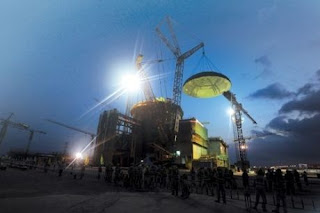
Brian Wang at Next Big Future brings some news regarding Chinese nuclear expansion, including that China is on track for 27(!!!) new plants being completed by 2015. I am sure witnessing the placing of a Reactor Dome in person would be quite a site to behold, and would easily trump seeing a crane move a Moisture Seperator Reheater (the "other" MSR besides Molten Salt Reactors).

ii1. From Things Worse Than Nuclear Power

In light of the national debates and elections, our current post (as of today) is the second in a 3-part series focusing on federal interventions in energy market, including subsidies, loan guarantees, tax preferences, R&D, and even lobbying.  Part 1, published the day of the first Presidential debate, called out issues which became headlines in the debate, including the loan guarantees to companies like Solyndra! 

1. 2 entries from musician and pro-nuclear power advocate Rick Maltese's blog Deregulate the Atom.

Summary: This is a re-posting of Facebook discussion about the fossil fuel industry's interference with the progress of nuclear energy. Robert Steinhaus makes a long comment about The Energy Reorganization Act of 1974. Rod Adams comments back. It demonstrates how government policy shifts can have a crippling effect.

 A Letter to the Newest Federal Liberal Candidate – Justin Trudeau 
Summary: Another letter added to my growing collection of reaching out to people of 

influence to spread the pro-nuclear word. In this case I appeal to their willingness 
to educate themselves about nuclear.

2. From Leslie Corrice's The Hiroshima Syndrome, these 2 entries can be found on the same page:

  http://www.hiroshimasyndrome.com/fukushima-accident-updates.html

October 10 Commentary...
"Antinuke Peter Bradford speaks with forked tongue" 
In a Wall Street Journal debate on nuclear energy viability, Peter Bradford takes the 
antinuclear side using time-worn rhetoric and making misleading statements, some of which are outright fabrications. Bradford's bombast literally demands this rational rebuttal.
(See Entreprenuclear post number 22 for additional Bradford debunking)
October 12......
No “Melt-throughs” at Fukushima Daiichi?  
Tepco has posted the results of the first water sample taken inside the unit #1 Primary Containment Vessel (PCV) at Fukushima Daiichi. We find results that come as more than a bit of a surprise. Given the differences with respect to the chemical make-up of the interior and exterior waters relative to the unit #1 PCV, and the fact that the highest radiation level inside the PCV is essentially parallel to the bottom head of the RPV (in today’s first update), I now believe it is possible that none of the reactors at Fukushima Daiichi experienced catastrophic RPV “melt-through”.


3. From Rod Adams' blog Atomic Insights

Theo Simon and George Monbiot – Rational discussion about nuclear energy development


During the past week or so, Rod Adams has been spending quite a bit of time following a discussion about nuclear energy between Theo Simon and George Monbiot. It is a deeply philosophical engagement between two literate and concerned people who view nuclear energy through different lenses and have, so far, reached different conclusions about its value and potential for growth.


Rod provides a third perspective and hopes that the development of smaller reactors may encourage additional deep thinking.


4. From the ANS Nuclear Cafe:

Howard Shaffer with a very interesting history of the founding of the anti-nuclear energy movement -- as told last week at UMass Amherst by two of the very persons who helped to found it, Anna Gyorgy and Lionel Delevingne.

http://ansnuclearcafe.org/2012/10/09/founding-the-anti-nuclear-movement/

Margaret Harding is blogging from the American Nuclear Society-sponsored Indo–US Nuclear Safety Summit in Mumbai, India.  Her notes on the discussions of regulatory issues, emergency risk assessment, international trade relations, economy, politics...

http://ansnuclearcafe.org/2012/10/11/update-from-mumbai/

http://ansnuclearcafe.org/2012/10/12/post-2-from-mumbai/

Check ANS Nuclear Cafe http://ansnuclearcafe.org/ for Harding's
continuing updates on news, and views, and traveler's tales, from the
Summit.


5. From the Yes, Vermont Yankee blog

Meredith Angwin revisits her area of technical expertise: PWR steam generators.  In "San Onofre Thoughts and Future. I told you so", Angwin quotes some of her earlier posts on the subject. She predicted the plant would be derated but start again. Plant opponents make endless negative predictions, and are all over the airwaves if even one of them comes true.  Angwin decided to trumpet her positive prediction this time. 

6. From Nuclear Diner:

Russia Plans to Raise Two Nuclear Submarine Reactors from Sea Floor

The Russian Defense Ministry is planning to raise and scrap two sunken nuclear submarines in the northern Barents and Kara seas. Susan Voss considers the reactors in those submarines and the hazards they may or may not pose. She also looks at Project Azorian, a 1968 CIA attempt to raise a sunken Soviet nuclear submarine.

7. From Will Davis's Atomic Power Review

Toshiba buys out Shaw
Although Will Davis is quite busy this week with a convention, he submits the press release from Toshiba on the put option Shaw has exercised on its Westinghouse stake (as well as links to other related stories) and invites readers to examine the very last line of the press release closely.


8. A posting from Jim Conca published by Forbes


9. William Tucker talks about the tragedy of Radiation Phobia at Nuclear Town Hall


10. Gail Marcus at Nuke Power Talk


At Nuke Power Talk, Gail Marcus discusses a recent article pointing out that the strong and positive link between the effectiveness of emergency response measures taken during the floods in Cedar Rapids in 2008 and the emergency response preparedness at the Duane Arnold nuclear power plant nearby. She also recalls a previous incident in which the emergency response preparations at another nuclear power plant proved to be very applicable and helpful for handling the emergency response for a chemical spill.  While communities should not depend on their nuclear neighbors to for emergency situations, the reality is that the more specific and stringent requirements imposed for nuclear power plants are a powerful spur to assuring that the necessary plans for an emergency are developed and maintained. 

And that concludes this week's Carnival entries.  Now, I will reveal the latest Entreprenuclear logo (actually created by a friend for me, not by me).  
(Disclaimer: My everyday attire does not consist of a Tie)

Wednesday, October 10, 2012

22. Debunking Antis (Peter Bradford) - The Weight of Lies

You may or may not have known it yet, but the Wall Street Journal has been conducting an online poll regarding the question "Should the World Increase Its Reliance on Nuclear Energy?". (Helpful Hint: click on the 1st entry of these search results, the WSJ gives access to things when accessed via Google search results). The poll has been up for at least several days, and I am not sure how much longer it will be up. If you have read any of the posts here, or met me in person, you could probably guess that my answer would be a resounding "HECK YES!! and faster than what we've done during any point in my lifetime (which began in the mid-80's)".

Within the past few days, commentary from Mark Lynas on the "pro-nuclear" side and from Peter Bradford on the "anti-nuclear" has been added. Mark Lynas is a British environmentalist and has relatively recently come to the realization that increasing the usage of nuclear power is an imperative for the world to have a successful future. Peter Bradford was a Nuclear Regulatory Commission (NRC) Commissioner from 1977 to 1982. He has since made a bit of a career for himself as an anti-nuclear activist.

I will let Mark's words stand on their own (although I make zero claims of possessing climate change expertise).

In this post, however, I will break down Mr. Bradford's editorial, add some corrections and/or things he omitted, and add in a video of a song from my favorite musicians, the chorus of which makes me think of anti-nuclear folks almost every single time I hear it. My strong speculation is that almost anyone who would wish to get in touch with Mark Lynas would have an opportunity, by simply Tweeting him. I imagine/speculate Mr. Bradford is much tougher to get in touch with (and I will leave it to the reader to guess how that sways my idea of the overall integrity of each man).

Additions:
1. My assertion regarding ease of getting in touch (despite an Atlantic amount of distance) has been proven true in under 12 hours.
2. Check out Leslie Corrice's commentary on Bradford's writing over at his Hiroshima Syndrome site.

The Breakdown/Analysis/DeBunking:

Bradford starts off with a straw man argument comparing the utilization of nuclear power to using caviar to fight world hunger. This is not even close to a comparable comparison on a cost basis. Additionally, many of the costs associated with nuclear construction have been concocted precisely by the actions of anti-nuclear activists combined with the timing of extreme inflation rates within the U.S. (see: this chapter of a free online book written by Bernard Cohen).

Bradford goes on to make the claim that the full impact on people's health from Fukushima won't be known for years, if ever (cue cheesy, scary sound effect). I disagree. The majority of the region around the Fukushima Daiichi Nuclear Plant following the Great East Japan Earthquake has had radiation levels far below those that cause harm to humans and far below the naturally-occurring levels of quite a few places around the world that experience no negative health effects. The over-exaggeration of potential negative health effects is, from my viewpoint, highly immoral in that it has caused actual harm while preventing no real harm.  I agree with Mr. Bradford that people not being able to return to their homes is a tragedy, but I actually realize that it is efforts of people like Mr. Bradford himself that are the biggest impediment to those people being allowed to return home, rather than trivial amounts of radiation that could be easily managed/worked around.   Next

Pete B., what do 1970's advertisements have to do with anything regarding the present discussion? The Shah was basically a puppet ruler put in place by the U.S. government, who was overthrown by the people of Iran. U.S. over-extension in Iran in 1953 is a major contributor to the Iran situation today. Bringing that up has ZERO relevance to today's nuclear power discussion.  Next

"If the next nuclear-power-related catastrophe is a bomb........." - Yet another fallacy. Nuclear power and nuclear weapons are not a "Like-for-Like" equivalent, Pete. The bomb pre-dated nuclear power. Diverting fissile material from a nuclear power plant to create a bomb would be a far-far-from-optimum way to obtain nuclear weapons. Find another straw man.  Next

"Of course new reactor designs are safer." Thanks, for admitting that, Pete. Maybe we can actually get somewhere with this discussion. "However, safety depends on more than design." I agree completely, Pete. Operations are highly important. I mean, Technical Specifications specifying the minimum requirements of plant OPERATION make up an integral portion of a plant's OPERATING license granted by the Commission you were once a part of (a fact you have utterly milked in your activities subsequent to 1982). Oh, you didn't mention that operations and maintenance also ensure safety. I'll grant that you simply forgot that.  Next

"A world more reliant on nuclear power would involve many plants in countries that have little experience with nuclear energy.........."  Mr. Bradford, to suggest that these countries wouldn't be completely willing, able, and eager to learn all the things that they would need to know to properly build, maintain, and operate nuclear power plants screams of an air of arrogance on your part. People are capable of learning, particularly if the reward will enhance their society's well-being.  Next

Expense - I covered this above   Next

Quoting John Rowe - See the Rod Adams collection on John Rowe. I will summarize for you. The way Exelon is currently structured and positioned, they have basically no incentive to build new plants as extra capacity would merely hurt the profit margin of their existing TWENTY-TWO CASH COW plants.
(Lengthy Disclosure: I have been intending to purchase Exelon stock for months now, and at under $36/share, I need to do it soon particularly with the possibility of a normal amount coldness this winter leading to considerably increased natural gas demand and somewhat increased natural gas price which equals increased profit margins for Exelon's TWENTY-TWO already-built, operating nuclear plants). Next

Then, Peter Bradford goes into full-on, Tea Party market-based capitalism-mode, which I doubt he would do for ANY other topic. I admit that there is a severe disconnect between "pure" free-market capitalism and the utility industry as a whole. There are rather complex and diverse market structures involved (including the U.S. Government Corporation that is the Tennessee Valley Authority). This disconnect is not reason to abandon nuclear power, it is a reason to figure out methods of properly figuring out how to plan for, pay for, and build nuclear power plants.

You can't decide you want a nuclear power plant one day and start getting power from it the next. If you could, a "pure" free-market capitalistic approach would show, unequivocally, in the long term that nuclear power is the most cost-effective energy source.

Now the Music:

And now for a song from my present favorite musicians. These guys are my favorite in large part because I have 2 brothers (one of whom actually called in the middle of me writing out this sentence), but also because these guys are extremely talented and put tons of ENERGY and emotion into their songs.


"How does this song apply to anti-nuclear activists?" you might ask. The chorus starts off with a slightly obvious statement "The weight of lies will bring you down", but the part that always made me think of anti-nuclear folks was the end of the chorus, "so when you run make sure you run; to something and not always from; cause lies don't need an aeroplane, to chase you down". 

The anti-nuclear movement is a move away from technological progress. I see no way to argue against that. Turning away from peaceful atomic energy would be a step backward for humanity, and would lead to enhanced energy scarcity in a time when increased energy abundance is needed to minimize physical human suffering. Bill Gates understands the situation, thus he has helped fund TerraPower. 

Thus, I say we (the World) should run TO increased reliance on Nuclear Power, so vote YES in the Wall Street Journal poll while it is still open.

/An Aside
Also, a link that was shared this evening on Facebook titled "5 Biggest News Stories that Left out the Most Important Part".  

#1 on the list: The "Fukushima 50" Sacrificed Their Lives to Prevent Disaster (also, They're All Still Alive)

Tuesday, May 1, 2012

10. Entreprenuclear View of Energy

Here at Entreprenuclear, the viewpoint is that Energy usage is a good thing that should not be villainized.

Energy can be defined in very simple terms as "the ability to do work" or according to wikipedia as "the ability a physical system has to do work on other physical systems".


Things don't get done if energy is not used.

No Energy = No Work (nor Jobs (and I don't mean Steve))

Reduction in the amount of energy used within an economy equals a reduction in the amount of useful things that can be done within that economy, which will equal an overall reduction of wealth within that economy.  It really is that simple.


While I am a fan of School House Rock and of not being wasteful in using energy, Atomic Energy (if allowed to flourish) can paint a much rosier picture than the video above.

The "favored" source of primary energy here at Entreprenuclear is, of course, Peaceful Atomic/Nuclear Energy.  This favored status is due to the lack of supply issues for nuclear fuel combined with a realization/knowledge that present limitations that have historically hindered Nuclear Energy from flourishing to its full potential are simply man-made, rather than true physical constraints.

Here is a recent posting at Nuclear Green about the lack of any supply issue for nuclear fuels, along with an additional illustration relating to how plentiful nuclear fuels can be from Kirk Sorensen here (which he admits in the comments does not give credit for further gains that would be available for Uranium if utilized within a fast neutron spectrum reactor).

Rod Adams posted a great blog this morning, mentioning that Nuclear Energy can allow mankind to enjoy the benefits of a high energy lifestyle (which include reduced human slavery, enhanced overall liberty/prosperity, and greater gender equality), while exerting a limited impact on the naturally-occurring global systems of the Earth.

All that is needed is for more people to keep understanding the benefits of nuclear energy and for those of us who already understand those benefits to do what we are able to be adding value in entrepreneurial ways in whatever aspects of Peaceful Atomic Energy that we can think of.

Saturday, April 28, 2012

9. Meager Initial Attempts at a Logo

Engineers aren't often known for their artistic abilities, but here are a few meager attempts at logos.

The one above is what I have added as the background of the blog. If you are reading on a wide enough screen, it might be visible. If you're reading it on a Smartphone or iPad, you may only see edges or none of it at all.

The one below is the one that I added as a profile picture for now for the Facebook (which has a misspelling in the address due to creating the Facebook page on my iPad) and Twitter profiles.
I will gladly accept other ideas and suggestions for some better logos. Just leave a comment down below or send an email to Entreprenuclear "At gee mail dot com" (typed as @gmail.com of course).

For some better examples of artistic ability relating to Nuclear Energy, go check out Pop Atomic or go read about this rather fascinating individual, James Acord, (also, a very interesting article about him here).

Thursday, April 26, 2012

8. Entreprenuclear View of PBS's "Electric Nation"

Here are my initial, shooting-from-the-hip thoughts on the program.

Only 4 and a half minutes for nuclear? Really? Nuclear provides 20% of America's electricity and it only got around 8% or 9% of this program's air time?

At one point, the program stated that Watts Bar Unit 2 is the only nuclear plant under construction, which is no longer true as of the past few months, with the approval of the combined Construction and Operating Licenses (COLs) for 4 AP1000's, 2 each at Vogtle in Georgia and VC Summer in South Carolina. They even showed site preparation work at Vogtle about a minute or two after stating that no new plants had been ordered since the 70's. Were Vogtle Units 3 & 4 not ordered, but work somehow magically got started there? Hello?


The recently announced changes to the schedule for completing Watts Bar Unit 2 were not included in the program either., but that is understandable since it was only made public a few weeks ago.

There was no mention of Small Modular Reactors (SMRs) in the initial nuclear power section, a market segment which I will be discussing in "shallow depth" in the near future.

Had I been telling the story, I would have expounded a lot more on the reasons the first nuclear build-out didn't meet President Nixon's 1974 projection that America could have 1,000 reactors by the beginning of the 21st century (which would have been fully possible without breaking any laws of physics).  Pure obstructionism, combined with approaching of electricity market saturation/slowed demand growth rates (see Note below) and combined with interest rates shooting up above 20% played considerably bigger roles in not meeting that projection than safety concerns did.  Here is a link explaining it further.  Stating that it was safety concerns is a lazy cop-out that fails to consider the whole situation, but this did admittedly all occur long before my birth.


Aside: People using the word safety in regards to nuclear power, with nothing close to any further explanation for how something specifically relates to nuclear safety is becoming more and more a pet peeve of mine with each successive 4-1 NRC Commission vote. /End Aside

In summary 

My expectations were met for the opening segment, which did do a good job of stating just how vital electricity is to modern day American life.  On the negative ledger though, for almost every other energy source that the program covered besides nuclear, some forward-looking attributes were the main things featured.  For natural gas, fracking shale was featured.  For wind, the fancy simulations of America's wind "resources" was shown.  For solar, a church was featured.  In the coverage of nuclear power, however, the very mild folly of the first nuclear era's over-exuberance was mentioned while barely a smidgen of the really forward-moving aspects of nuclear power were featured outside of the short clip of site preparation work at Vogtle.

The way things were presented in this particular program is a prime example of precisely the information and optimism void in regards to the use of Peaceful Atomic Energy that Entreprenuclear is here to play a small role in filling.


Note: People didn't generally need more and more refrigerators, air conditioners, and other appliances after getting their first ones in the 50's, 60's, and early 70's. Therefore, electricity load growth projections from that era turned out to be unsustainable.  What would a person do with a 3rd washer and dryer?

Tuesday, April 24, 2012

7. A Short TV Programming Note


At 10 pm, April 25th, "Electric Nation" aired on PBS. This program included a very short tour of Watts Bar Nuclear Plant's Unit 1.  I believe this link will allow watching the program online in the future, but it was having technical difficulties at the time I copied and pasted the address.  Here is a preview.


I have not gotten to preview the episode or anything and cannot vouch for its content, but my unverified assumption is that it will at the very least help point out just how important electricity is and how useful it is.

We far too often take electricity for granted. This Friday (4/27) marks the first anniversary of the record-breaking string of tornados that swept through portions of the Southeastern U.S. (which is where I happen to reside). That series of storms provided an unpleasant reminder of how important electricity is to our modern, first-world way of life here in America.

So, if you aren't busy tomorrow night, take the time to be educated a little by watching the special on PBS. Or if you're rather busy like me, record it on your DVR of choice to watch later. Hopefully the program will be devoid of any significant political slants.

Oh, and a solid rule of thumb, always be sure to check your local listings.  The program could re-air sometime, or it may be placed online, in which case I will add a link to this posting.

Friday, April 13, 2012

1. Entreprenuclear? What’s that?


Entrepreneur + Nuclear
=
Entreprenuclear 

“What does that mean?”, you might ask. If you have a few minutes to read, I would be happy to tell you.

Entreprenuclear is more than simply a convenient amalgamation of two words that both possess a “new”sound. Entreprenuclear is starting off as simply a pro-nuclear,and hopefully insightful and informative, blog. I intend to use Entreprenuclear's corner of the Internet to educate and encourage people in regards to the peaceful use of Atomic (aka Nuclear) Energy,championing value-creating Innovation and Entrepreneurship.

Nuclear energy, even it its present state, is downright incredible. To think that several truckloads of fuel delivered to a single unit can provide the electrical power needs for hundreds of thousands of (nearly a million) people for 18-24 straight months at a time is amazing if you actually think about it. Oh, and thinking will be encouraged here at Entreprenuclear.

As incredible as the existing,operating, commercial nuclear power plants are, Peaceful Atomic Energy has not yet come close to reaching its full potential. Present commercial nuclear power plants use LESS THAN 5%of their potential fissile energy (sparing any details of this calculation, for now). Even considering this lack of maturity, fully fabricated nuclear fuel costs approximately one third on a per unit of energy basis ($0.65-0.92/MBtu) of even natural gas which is presently at a 10-12 year low price in North America(dipping below $2.00/MBtu,at the Henry Hub) .

Looking at only those facts, nuclear energy would seem to be ripe for value creating innovation and entrepreneurship,right?

Well many people would likely say no and that nuclear power plants are inherently expensive or that regulations prevent much of any innovation or opportunities for entrepreneurship.

While I would likely agree with those people that building nuclear power plants is far from an easy task and that it does NOT provide short term pay-backs, the long-term benefits of being patient and properly completing a high quality nuclear power plant (NPP) are almost amazing in terms of energy supply security and electricity rate stability. The alleged inherently expensive nature of NPPs and the present structure of nuclear regulation actually probably present the two areas of greatest entrepreneurial need in regards to the use of Peaceful Atomic Energy.

Further education will be necessary on many fronts for a large portion of the advances that Peaceful Atomic Energy is poised to make. I may simply be a nerd (mechanical engineer by schooling), but I think that in some ways, “nuclear people” historically have done themselves a disservice by being far too willing to allow non-”nuclear people” to believe that understanding nuclear fission is beyond their intellectual capabilities. I say that on a basic level, that is patently FALSE. Yes, there are many details that I am also clueless about and that are best learned by earning a difficult BS, MS, or PhD degree, but EVERYONE should strive to have some understanding of the basics of nuclear power production. I plan to make efforts to provide some simplistic explanations here at Entreprenuclear.

Entreprenuclear is here to encourage both present and FUTURE “nuclear people”. Entreprenuclear will try to highlight upcoming advances in nuclear power technologies (attempting to stay relatively agnostic in regards to any particular technology, since advancement is advancement), highlight entrepreneurial news regarding new nuclear ventures, and also promote INTRApreneurship within existing established nuclear energy organizations.  Submissions of examples of EntrepreNuclear or IntrapreNuclear activities will be welcomed here at Entreprenuclear and in some cases could result in a blog entry highlighting the activity (with permission, of course).

The future is what nuclear energy is really about, a future that I am hopeful isn't laced with mandated decreases of utilizing energy, whether mandated by governments or nature via depleted fossil fuel resources.  Decreasing usage of energy would equal decreased economic activity and decreased standards of living, for the whole world, in addition to likely fights for scarce remaining fossil fuel resources. I am hopeful that peaceful atomic energy will be allowed to advance and flourish in the future world that will be inhabited by any children, grandchildren, and great-grandchildren that I may someday bring into the world. I previously shared some of these Atomic Dreams this past Martin Luther King Day on Atomic Insights.

Peaceful Atomic Energy is basically still in its first product cycle past prototyping. There are miles of improvements that can be made for the future (not to say that the nuclear plants that are already operating aren't quite incredible), both in regards to new designs and in how currently operating plants are managed, supported, and operated.

The second posting here will list some of the on-going entrepreneurial activities and opportunities within the realm of Peaceful Atomic Energy. 

Note:
Constructive, non-spam comments and questions will always be welcome here at Entreprenuclear. I am more than willing to admit that I myself still have much to learn.