Showing posts with label Westinghouse. Show all posts

Wednesday, April 3, 2013

30. Call Me "Johnny Atomicseed"

In addition to being something of a folk hero, "Johnny Appleseed" was an actual real-life pioneer who lived in the early days of America's existence. His actual name was John Chapman. American school children grow up learning that Johnny Appleseed traveled the American country-side in the pioneer days, planting apple seeds (or at least they learned that back in the late-1980's and early-1990's).
Depiction of Johnny Appleseed: If anyone has free time to create a Johnny Atomicseed logo, please do

So, I know you are asking "What does Johnny Appleseed have to do with Peaceful Atomic Energy?"

Nuclear power is an investment in future generations. It is an investment in technological progression. To oppose nuclear power is to be in favor of either a large amount of increasing combustion to meet energy needs or "Endarkenment" (Also: in favor of additional deaths in comparison to alternative means of cost-effective, reliable generation according to this recent study).

Like planting apple trees (or other fruit trees), building nuclear power plants is not an investment that pays off in the short-term. It is a long-term investment that provides benefits further into the future. You can't bake an apple pie next month from apples grown on a tree you decide to plant in your yard today. However, if you do decide to plant an apple tree today, 10 years or so from now (depending on many factors), you should have the benefit of some home-grown apples.

Nuclear power is not conducive to a mere quarterly financials-style outlook, which is far too common the default in today's society.

"How does building new nuclear plants pay off?" you ask. 

By providing the lowest life-cycle cost of electricity generation.

Even considering the massive investment outlay of roughly $14 Billion for the 2 new Westinghouse AP1000's being installed at Vogtle near Augusta, GA, the total life cycle cost of the electricity is estimated to be up to $4 Billion less than the next best generation option. The reason that number is uncertain and requires the words "up to" in front of the $4 Billion is primarily due to the volatility and future uncertainty of natural gas prices. From March of 2012 to March of 2013, the Henry Hub spot price of natural gas fully doubled from a low of under $2.00/MMBtu to over $4.00/MMBtu within the past few weeks.

For a similar real-world lowest-cost estimate, FPL/NextEra Energy estimates (per this fact sheet) that their Extended Power Uprate (EPU) projects at St. Lucie and Turkey Point would save their customers approximately $3.8 Billion for the time period of the remaining life of the 4 Units in comparison to other generating options.

Feel free to question these numbers from both Southern Company and FPL, but these 2 utilities are required to testify in front of public service commissions to justify that their costs for adding this new generation are reasonable and prudent, and they wouldn't have undertaken these projects if they didn't trust their own math.

The same FPL fact sheet linked above mentions that 2 new AP1000's at Turkey Point (Units 6 and 7) would save customers $58 Billion over their operational lifetimes. That even almost sounds absurd to me right off hand before giving it much thought. If you actually stop to consider that 2 AP1000's will generate 1100 MWe each, should be fully capable of operating for 60-80 years, and that the residential price of electricity in the presently nuclear generation-free Los Angeles area is about $0.23/kW-hr, the $58 Billion savings number starts to actually make a decent amount of sense. Would anyone want to sell me any natural gas futures with a 2030 delivery date at even $6.00/MMBtu?

Even further into the future

So far, I have only referred to conventional Gen II and III light water reactors (LWRs). Plenty of potential exists in the future for Generation IV reactor designs with many, many improvements over Gen II and III designs, particular in terms of the utilization of natural Uranium. Nuclear power being allowed to continue to progress will "plant seeds" for future generations to properly utilize the naturally-occurring 0.7% of Uranium that is fissile U-235 to be the seeds for virtually unlimited power by way of breeding fertile Thorium and the 99.3% of natural Uranium that is U-238, while reducing other potential impacts to levels below even the minuscule impacts of the present generation of light water reactors.

Nuclear power is an investment in the future. From my viewpoint of knowing a great deal about it, and about its potential for even further future improvements, I think nuclear power is THE investment in the world's future. A new nuclear power project started today won't pay dividends next quarter, but over the next 60-100 years, it will help make the world a better place by helping more people get close to a situation of having Energy Abundance.


Disclaimer: I did notice when I Googled the terms "Johnny Appleseed" and nuclear, that A.Q. Khan popped up several times with people calling him a nuclear Johnny Appleseed due to his role in past weapons proliferation, but that was not even close to the point of my post. Here at Entreprenuclear, I prefer to stick to talking about the benefits of peaceful atomic energy. So, I will  

Saturday, October 13, 2012

24. 126th Carnival of Nuclear Energy Bloggers


When I was asked earlier this week if I would be interested in hosting the Nuclear Blog Carnival, I was more than happy to Volunteer for the task. I didn't realize it at that moment, but the 126th Blog Carnival marks exactly 6 months (Friday the 13th, April 2012) since I finally started up the blog. The impetus for me to finally launch was to have a submission included in the 100th Carnival.  I consider it an honor to have been asked to host. 

Enough intro, here we go with the past week's best Nuclear Postings:

i1. UPDATE/ADDITIONAL Submissions

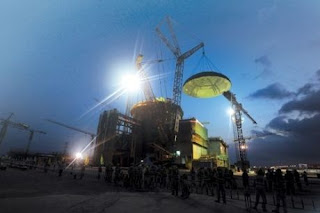
Brian Wang at Next Big Future brings some news regarding Chinese nuclear expansion, including that China is on track for 27(!!!) new plants being completed by 2015. I am sure witnessing the placing of a Reactor Dome in person would be quite a site to behold, and would easily trump seeing a crane move a Moisture Seperator Reheater (the "other" MSR besides Molten Salt Reactors).

ii1. From Things Worse Than Nuclear Power

In light of the national debates and elections, our current post (as of today) is the second in a 3-part series focusing on federal interventions in energy market, including subsidies, loan guarantees, tax preferences, R&D, and even lobbying.  Part 1, published the day of the first Presidential debate, called out issues which became headlines in the debate, including the loan guarantees to companies like Solyndra! 

1. 2 entries from musician and pro-nuclear power advocate Rick Maltese's blog Deregulate the Atom.

Summary: This is a re-posting of Facebook discussion about the fossil fuel industry's interference with the progress of nuclear energy. Robert Steinhaus makes a long comment about The Energy Reorganization Act of 1974. Rod Adams comments back. It demonstrates how government policy shifts can have a crippling effect.

 A Letter to the Newest Federal Liberal Candidate – Justin Trudeau 
Summary: Another letter added to my growing collection of reaching out to people of 

influence to spread the pro-nuclear word. In this case I appeal to their willingness 
to educate themselves about nuclear.

2. From Leslie Corrice's The Hiroshima Syndrome, these 2 entries can be found on the same page:

  http://www.hiroshimasyndrome.com/fukushima-accident-updates.html

October 10 Commentary...
"Antinuke Peter Bradford speaks with forked tongue" 
In a Wall Street Journal debate on nuclear energy viability, Peter Bradford takes the 
antinuclear side using time-worn rhetoric and making misleading statements, some of which are outright fabrications. Bradford's bombast literally demands this rational rebuttal.
(See Entreprenuclear post number 22 for additional Bradford debunking)
October 12......
No “Melt-throughs” at Fukushima Daiichi?  
Tepco has posted the results of the first water sample taken inside the unit #1 Primary Containment Vessel (PCV) at Fukushima Daiichi. We find results that come as more than a bit of a surprise. Given the differences with respect to the chemical make-up of the interior and exterior waters relative to the unit #1 PCV, and the fact that the highest radiation level inside the PCV is essentially parallel to the bottom head of the RPV (in today’s first update), I now believe it is possible that none of the reactors at Fukushima Daiichi experienced catastrophic RPV “melt-through”.


3. From Rod Adams' blog Atomic Insights

Theo Simon and George Monbiot – Rational discussion about nuclear energy development


During the past week or so, Rod Adams has been spending quite a bit of time following a discussion about nuclear energy between Theo Simon and George Monbiot. It is a deeply philosophical engagement between two literate and concerned people who view nuclear energy through different lenses and have, so far, reached different conclusions about its value and potential for growth.


Rod provides a third perspective and hopes that the development of smaller reactors may encourage additional deep thinking.


4. From the ANS Nuclear Cafe:

Howard Shaffer with a very interesting history of the founding of the anti-nuclear energy movement -- as told last week at UMass Amherst by two of the very persons who helped to found it, Anna Gyorgy and Lionel Delevingne.

http://ansnuclearcafe.org/2012/10/09/founding-the-anti-nuclear-movement/

Margaret Harding is blogging from the American Nuclear Society-sponsored Indo–US Nuclear Safety Summit in Mumbai, India.  Her notes on the discussions of regulatory issues, emergency risk assessment, international trade relations, economy, politics...

http://ansnuclearcafe.org/2012/10/11/update-from-mumbai/

http://ansnuclearcafe.org/2012/10/12/post-2-from-mumbai/

Check ANS Nuclear Cafe http://ansnuclearcafe.org/ for Harding's
continuing updates on news, and views, and traveler's tales, from the
Summit.


5. From the Yes, Vermont Yankee blog

Meredith Angwin revisits her area of technical expertise: PWR steam generators.  In "San Onofre Thoughts and Future. I told you so", Angwin quotes some of her earlier posts on the subject. She predicted the plant would be derated but start again. Plant opponents make endless negative predictions, and are all over the airwaves if even one of them comes true.  Angwin decided to trumpet her positive prediction this time. 

6. From Nuclear Diner:

Russia Plans to Raise Two Nuclear Submarine Reactors from Sea Floor

The Russian Defense Ministry is planning to raise and scrap two sunken nuclear submarines in the northern Barents and Kara seas. Susan Voss considers the reactors in those submarines and the hazards they may or may not pose. She also looks at Project Azorian, a 1968 CIA attempt to raise a sunken Soviet nuclear submarine.

7. From Will Davis's Atomic Power Review

Toshiba buys out Shaw
Although Will Davis is quite busy this week with a convention, he submits the press release from Toshiba on the put option Shaw has exercised on its Westinghouse stake (as well as links to other related stories) and invites readers to examine the very last line of the press release closely.


8. A posting from Jim Conca published by Forbes


9. William Tucker talks about the tragedy of Radiation Phobia at Nuclear Town Hall


10. Gail Marcus at Nuke Power Talk


At Nuke Power Talk, Gail Marcus discusses a recent article pointing out that the strong and positive link between the effectiveness of emergency response measures taken during the floods in Cedar Rapids in 2008 and the emergency response preparedness at the Duane Arnold nuclear power plant nearby. She also recalls a previous incident in which the emergency response preparations at another nuclear power plant proved to be very applicable and helpful for handling the emergency response for a chemical spill.  While communities should not depend on their nuclear neighbors to for emergency situations, the reality is that the more specific and stringent requirements imposed for nuclear power plants are a powerful spur to assuring that the necessary plans for an emergency are developed and maintained. 

And that concludes this week's Carnival entries.  Now, I will reveal the latest Entreprenuclear logo (actually created by a friend for me, not by me).  
(Disclaimer: My everyday attire does not consist of a Tie)