Saturday, March 30, 2013

29. Energy Abundance, The Moral High Ground

Using energy does not make you a bad person.

A dangerously seductive idea has been adopted by many very intelligent people overestimating the possible benefits that can be obtained by foregoing the usage of energy/electrical power. The term "Negawatt" has been derived to refer to an amount of energy saved. Please, DO NOT twist my words to suggest that I am against the elimination of wasteful usages of energy or am against pursuing increasing energy efficiency, as I would disagree with either assessment. That said, I would like to make several points.

"Negawatts" have never powered desalination plants to change a single gallon of ocean water into clean drinking water or powered a single piece of life-saving medical equipment. Would anyone argue that those aren't desirable?

A "negagallon" of fuel has never powered the transportation of any person anywhere or delivered any goods to a new destination. The freedom provided by access to transportation is a major positive. Thanks to me owning a road-worthy personal vehicle and to the existing infrastructure of fueling stations, I was able to decide during the day on Friday (the same day as she broke her hip and had surgery) to travel 7 hours to visit my grandmother in the hospital 3 states away. I will fortunately be joined in the car by my two brothers who each live more than 4.5 hours away from me. Having the freedom of transportation to be able to travel and visit family (or friends) is certainly something that can easily be called a good thing.

A "negawatt-hr" of electricity has never powered a dishwasher or washing machine, 2 appliances which drastically reduce the needed human input time of accomplishing household chores. I would have considerably less time to read blogs if I had to handwash my clothes. Do you think that there might be a few people living in the less well-developed parts of the world today that would be happy to have the opportunity to have leisure time, rather than needing to strive for survival at every instant?

Negawatts don't keep lights on at night to allow people to study, learn, and improve their overall positions in life. Yes, candles can provide some light at night, but they do pose a higher fire risk than most electric lights.

On occasion, I have little thoughts of self-doubt that my goals of increasing the availability of energy and electricity will simply allow people to become increasingly lazy and be able to do more completely non-value added things, like send cat pictures around the Internet. (Ok, I admit that there is an ever-so-slight amount of value added by the 1,322,650,448th cat picture.) Yes, more cheap energy availability is likely to cause an increase in frivolous or wasteful uses of energy. When I think about the positive aspects of access to energy, though, like being able to travel three states away at almost the drop of a hat to join my Mom in visiting her Mom in the hospital, the positive aspects of access to energy far outweigh the meager negatives of greater potential for laziness and of increased frivolous usages of energy.

With access to sufficient energy, other needs like food and drinking water are fully attainable. Energy poverty begets poverty of all forms.

Guilt-derived negawatts "generated" (sarcasm intended) within America will do nothing to solve poverty in other parts of the world. Increased usage of nuclear energy, particularly within markets beyond baseload electric power, has the potential to enhance energy and thus other resource abundance, significantly reducing worldwide poverty. These effects would subsequently enhance people's levels of freedom and reduce the incentive to fight over constrained resources, since with abundant energy, other essential resources would become increasingly abundant. People whose needs are met are much less likely to feel a need to fight.

Late addition: Here is a song titled with what you don't need to feel.

Never feel any shame or guilt for utilizing energy for a non-frivolous purpose that fits within your personal budget. Don't be seduced by the idea that a soft energy path is a path that leads to a better future. A truly better future for the world is a future with increasingly affordable energy abundance, with minimal environmental impacts. Increasing usage of peaceful nuclear power and new beyond baseload electricity utilizations of nuclear energy are a means of achieving such a desirable future of abundance.

Avoidance of energy usage is not inherently morally superior to the numerous positive uses of energy.

Saturday, March 16, 2013

28. Nuclear Risks are Acceptable, YOLO

Up-front Warning, this post will include a humorous video courtesy of Andy Samberg's "The Lonely Island" (which also features Maroon 5's Adam Levine). Skip ahead and scroll down to watch that if you don't care all that much about reading how I tie it into Nuclear Power. Now, on to your completely irregularly-scheduled Entreprenuclear blogging.


Earlier this week, I read this excellent piece written by Dr. Robert Hargraves (author of Thorium: Energy Cheaper than Coal) regarding how opposition to nuclear power approaches superstition. There is no point in me re-hashing that post here, so just go read it.

HERE is an even bigger link to it. (note the interesting list of publications at the end that chose not to publish it)

On a very similar note, not too long ago on Forbes, this article from Jim Conca described how the risks of low-level radiation are so small that they get lost among all other background risk factors. I also recommend reading this article if you haven't yet and get a chance. 

Now for the embedded funny video, which I will then (hopefully sufficiently) relate to the gist of this posting, in case it is somehow non-obvious to anyone who might read this.


Oh, in case you're reading my blog somewhere that is not conducive to watching the video embedded above, I will describe it for you. The video is from the group The Lonely Island and features Maroon 5's Adam Levine (also one of the judges on "The Voice"). If you are familiar with The Lonely Island, their videos have often been featured on the highly popular show Saturday Night Live, often simply referred to as SNL. The song is titled YOLO, which stands for "You Only Live Once". The song and music video accomplish what I found to be an outstanding job of poking fun at the idea of people being excessively risk averse in stark contrast to the presently-popular "YOLO" mantra (the battle cry of a generation, per this song).

The song starts off with the lyric "This life is a precious gift, so don't get too crazy, it's not worth the risk." Lonely Island then takes this absurdity of risk aversion to the extreme by suggesting such things as you should pull out all your teeth to avoid biting your tongue and that you shouldn't go to loud clubs because it is bad for your ears. It suggests burying all your money in your backyard, never traveling anywhere by any mode of transportation, and wearing a titanium suit in case a piano might fall on you. Basically, nothing in life is 100% safe, and to actually live a life worth living, taking risks is an absolute necessity.

Most people probably wouldn't immediately think so, but fears of low-level radiation from nuclear power are every bit as outlandish as the risk aversion that The Lonely Island parodies in "YOLO". The reason that might not seem to be the case for many people is that people have been systematically taught over the course of decades to have outlandish fears of radiation (even at levels below detectable/discernible impacts). Here is a graphic from IDigUMining.com of the ACTUAL numbers for how safe various sources of energy are.

Risks from low-level radiation are minuscule (also sometimes spelled miniscule), to the extent that they get lost in the statistical noise. Risks of having insufficient energy are much, MUCH greater.

The total production capacity of the worldwide economy is limited by the amount of useful energy available to be used. To attempt to claim otherwise would be a losing battle. People currently living in poverty in the world could best be brought out of their poverty by having sufficient access to clean and reliable energy. Having more energy at a person's command gives them the opportunity to more access to clean water and to sufficient food. Energy also gives people sufficient freed up time doing more than merely surviving the day that they can become educated, and even pursue leisure activities.

Regardless of possible anthropogenic global warming impacts from CO2 emissions, I absolutely don't believe that the world has sufficient quantities of easily accessible fossil fuels to pull the existing population of impoverished people out of their poverty. Therefore, as inhabitants of planet Earth, we need to increase the percentage of our energy that is derived from peaceful atomic/nuclear sources.

To be afraid of nuclear power or to be anti-nuclear because of nuclear power's risks, when viewed in light of the risks that would be presented by insufficient access to energy, is equivalent to the absurdity of cutting out your teeth to avoid the risk of biting your tongue.

YOLO - You Only Live Once, preferably not in Energy Poverty

Saturday, February 9, 2013

27. Musings on Unused CR3 Steam Generators


There was some somewhat bad news in the nuclear world this week. Duke Energy announced that the Crystal River Unit 3 (CR3) nuclear plant, that was obtained as part of the Duke-Progress merger, will be decommissioned rather than repaired after not operating since a 2009 outage.

During the 2009 outage, a hole had to cut in the containment to allow for new steam generators to be installed. As part of cutting the hole, the containment's concrete was cracked. An initial crack was repaired, but then in 2011, there was additional damage. This put Progress Energy, and following the merger Duke Energy, into the position of having a very tough decision to make of whether it would prove to be economical to repair the containment. It should be noted that the damage was not irreparable damage, but that the repairs carried enough uncertainty (both cost and schedule-wise) that the damage proved to be uneconomical to repair.

The 2009 outage included replacing CR3's steam generators. Replacing steam generators is far from a trivial maintenance operation, considering steam generators weigh in the hundreds of tons. Here is a rather incredible time-lapse video of the replacement of the 4 steam generators at Sequoyah Unit 2 which occurred towards the end of 2012.


Since Crystal River 3 never came back online following that outage, the steam generators have never entered service and should be brand new for all intents and purposes. With such valuable pieces of equipment being free of any wear and tear (other than being welded into place within the CR3 reactor coolant system, feedwater system, auxiliary feedwater system, steam generator blowdown, and main steam systems), it would be nice if they could somehow be re-used somewhere for their designed purpose of generating steam (with zero emissions, of course).

Being the entrepreneurial thinker that I am, I spent a few minutes trying to think of a few options to re-use these very valuable components. Here are the 3 options, in the order in which they came to mind.

1. San Onofre Nuclear Generating Station (aka SONGS) Units 2 and/or 3

This would almost be a perfect match, considering the SONGS early-life steam generator wear issue that has kept both Units 2 and 3 there shut down since January 2012. Sadly though, there are several extremely intractable problems that would arise from trying to fit the CR3 steam generators into either unit at SONGS that would make such an arrangement an impossibility economically. CR3, being a B&W-designed plant, has a completely different steam generator design than the Combustion Engineering-designed plants at San Onofre. The engineering and modifications that would be necessary to put once-through B&W steam generators (OTSGs) into a Combustion Engineering plant with U-tube steam generators would be intractable, sadly. It would be pretty far beyond trying to fit a square peg into a round hole. The biggest reason for this being that OTSGs have the primary side water enter at the top of the steam generator, whereas U-tube steam generators have the primary side enter at the bottom.

Additionally, Crystal River’s lower designed core thermal power (2609 MWt) would be poorly matched to the designed core thermal power of either of the San Onofre units (3438 MWt). The power level would be rather close to the 70% level that has been proposed by the owners of San Onofre Unit 2 for the trial 5-month period after restart.

2. TVA's Bellefonte Unit 1, scheduled to come online around 2021-ish

TVA had maintained the partially/mostly-completed plants at Bellefonte for quite a few years prior to cutting into their steam generators and selling the metal from the steam generator tubes in the 2006 or 2007 time-frame. With no tubes, a steam generator is basically worthless for its intended purpose. So, as one of the earliest steps following the August 2011 decision to complete construction of Unit 1 at Bellefonte, the procurement process for new steam generators was at least kick-started. I have no knowledge of how far along that process is, but I do know that Bellefonte, like CR3, is a B&W-designed plant. The 2 plants at least share the once-through steam generator (OTSG) aspect of their design. Sadly, the power level of Bellefonte is grossly mismatched from what the CR3 SGs were designed for (3,600 MWt vs. 2609 MWt , >1200 MWe vs. < 900 MWe, and 205 fuel assemblies vs. 177 fuel assemblies).

3. One of the 3 Duke-owned Units at Oconee  

Ah, finally, this could be a great place to utilize this pair of enormous and valuable components - three units to pick from, B&W-designed, entered initial operation at almost the same time as Crystal River Unit 3, now owned by the same parent utility as CR3 following the Duke-Progress merger, and nearly exactly the same power level as CR3 (2,568 MWt vs. CR3's 2,609 MWt). But alas, the 3 units have had their SGs replaced since 2003, so with a good chemistry program in place to prevent corrosion, etc. the units at Oconee could very well not need new steam generators during the duration of the 20-year license extensions they have already received. Maybe they will need them during a subsequent 20-year renewal period.

Concluding

So, maybe there is no good way to actually utilize the Crystal River Unit 3 steam generators at this time. The amount of work that would be required to remove them from CR3 and transport them to anywhere other than where they are positioned right now within the CR3 containment building would be considerably expensive, so the best place for them at this time is likely right where they are. Also, as the NEI blog, Nuclear Notes, noted in a posting on the same subject, who knows what the future might hold. Perhaps Rod Adams will prove prophetic in his bet with Steve Skutnik regarding natural gas prices and repairing Crystal River could make economical sense.

Tuesday, February 5, 2013

26. A Nuclear Power/Unmanned Aerial Vehicle Analogy

After finishing up my evening run today, I came across an article about Universities preparing students to work within the coming domestic drone/unmanned aerial vehicle (UAV)/remotely-piloted aircraft industry. I don't anticipate this posting to be especially profound, but simply a slightly intriguing analogy.

Here is a link to the article.

So, if you've read many of my postings here, you're probably asking, "What in the world does this have to do with peaceful nuclear power?" Well, I am about to tell you.
This image of a UAV was posted on Dan Yurman's now-retired blog Idaho Samizdat 

The main comparison that jumped out at me between the impending useful, economical, and peaceful uses of drones domestically and useful, economical, peaceful, atomic energy is that they have had and will continue to have perception problems to overcome. In general terms, these perception issues both stem from the same roots - that unmanned aerial vehicles and harnessing the power of the atom both made immense development strides solely due to military uses. Numerous other technologies that are now in use in everyday life share a comparable origin in terms of their militarily-derived developmental paths, but they have managed to not carry a stigma.

I anticipate that the term drone will carry more of a negative stigma than the acronym UAV and that UAV will carry more of a negative stigma than "remotely-piloted aircraft", despite them all being the same thing. For branding purposes, many domestic drone operations will probably jettison the term drone as quickly as possible. I don't have an immediate recommendation for a more publicly-accepted name for nuclear power, but going back to Dwight D. Eisenhower's Atoms for Peace program I like to emphasize here that nuclear power is a peaceful use of atomic energy.

Slight Aside: Consider this sentence my acknowledgement that there are definite privacy concerns to be hashed out relating to UAVs, but my purpose here is not to discuss those aspects.

I am not about to say that UAVs are going to come anywhere close to being as important to the global economies future as I believe nuclear power is and will be, but they will provide a lot of economical utility for legitimate, peaceful, and non-invasive purposes. Hopefully the stigma for both technologies can be lessened for the usages that deserve no stigma.

As I said, nothing profound, just an interesting analogy that I noted.

Tuesday, January 29, 2013

25. End of Unplanned Entreprenuclear Hiatus

I haven't posted a new blog in a long time. Sorry about that. Here are my lame excuses. Since December, I have had 2 interstate moves as well as changed jobs (don't worry, still working in nuclear power). I think the main factor in ending this hiatus is that I have actually gone for a few runs in the past few days.

I will try to keep this short, so I will simply post a few semi-related things that I came across today.

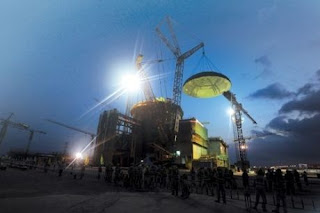
First, some very good news by way of what in my humble opinion is a very, very beautiful picture.
What is going on in that picture you might ask? Well, the top of the containment dome of Sanmen Unit 1 in China is being put into place. That is the WORLD's very FIRST AP1000 reactor, which is the same type of reactor that Units 3 and 4 at Vogtle, Units 2 and 3 at VC Summer, and someday Units 6 and 7 at Turkey Point will be. This is very good news. Thanks to World Nuclear News for posting the picture and this writeup.

The plant's polar crane was put into place about a week ago, which obviously needed to be completed prior to putting the top of the containment dome into place. The plant should enter commercial operation fairly early next year (2014).

So, how important is it for China to be getting so close to completing this nuclear reactor? Check out today's post from the Energy Information Administration. Coal consumption since 2000 worldwide, excluding China's growth, has only increased by 1%. But 2.3 billion of today's entire consumption of 8.1 billion tons has come from Chinese growth since merely 2000. China isn't going to slow their economic growth simply to meet any emissions targets. The only thing that can slow down China's increasing consumption of coal is for China to finish building more and more nuclear power plants.
Luckily, that is their plan with the 4 AP1000's they presently have under construction and their future plans to modify the AP1000 design into their own CAP1400. Here is a link to the English version of China's State Nuclear Power Technology Corporation website.


Update, 2 better pictures from China, thanks to the AP1000 Facebook Page (Entreprenuclear also has a Facebook page):
Click the picture above for a larger version.


There has also been a lot of exciting recent news regarding the increasing number of environmentalists coming to the realization of nuclear power's environmental benefits, particularly reviews of the documentary that recently debuted at the Sundance Film Festival, Pandora's Promise. On that topic, The Breakthrough Institute's Michael Shellenberger appeared  last night on The Colbert Report (silent T's, of course) which you should be able to watch either below or at the Colbert Report site.

Saturday, October 13, 2012

24. 126th Carnival of Nuclear Energy Bloggers


When I was asked earlier this week if I would be interested in hosting the Nuclear Blog Carnival, I was more than happy to Volunteer for the task. I didn't realize it at that moment, but the 126th Blog Carnival marks exactly 6 months (Friday the 13th, April 2012) since I finally started up the blog. The impetus for me to finally launch was to have a submission included in the 100th Carnival.  I consider it an honor to have been asked to host. 

Enough intro, here we go with the past week's best Nuclear Postings:

i1. UPDATE/ADDITIONAL Submissions

Brian Wang at Next Big Future brings some news regarding Chinese nuclear expansion, including that China is on track for 27(!!!) new plants being completed by 2015. I am sure witnessing the placing of a Reactor Dome in person would be quite a site to behold, and would easily trump seeing a crane move a Moisture Seperator Reheater (the "other" MSR besides Molten Salt Reactors).

ii1. From Things Worse Than Nuclear Power

In light of the national debates and elections, our current post (as of today) is the second in a 3-part series focusing on federal interventions in energy market, including subsidies, loan guarantees, tax preferences, R&D, and even lobbying.  Part 1, published the day of the first Presidential debate, called out issues which became headlines in the debate, including the loan guarantees to companies like Solyndra! 

1. 2 entries from musician and pro-nuclear power advocate Rick Maltese's blog Deregulate the Atom.

Summary: This is a re-posting of Facebook discussion about the fossil fuel industry's interference with the progress of nuclear energy. Robert Steinhaus makes a long comment about The Energy Reorganization Act of 1974. Rod Adams comments back. It demonstrates how government policy shifts can have a crippling effect.

 A Letter to the Newest Federal Liberal Candidate – Justin Trudeau 
Summary: Another letter added to my growing collection of reaching out to people of 

influence to spread the pro-nuclear word. In this case I appeal to their willingness 
to educate themselves about nuclear.

2. From Leslie Corrice's The Hiroshima Syndrome, these 2 entries can be found on the same page:

  http://www.hiroshimasyndrome.com/fukushima-accident-updates.html

October 10 Commentary...
"Antinuke Peter Bradford speaks with forked tongue" 
In a Wall Street Journal debate on nuclear energy viability, Peter Bradford takes the 
antinuclear side using time-worn rhetoric and making misleading statements, some of which are outright fabrications. Bradford's bombast literally demands this rational rebuttal.
(See Entreprenuclear post number 22 for additional Bradford debunking)
October 12......
No “Melt-throughs” at Fukushima Daiichi?  
Tepco has posted the results of the first water sample taken inside the unit #1 Primary Containment Vessel (PCV) at Fukushima Daiichi. We find results that come as more than a bit of a surprise. Given the differences with respect to the chemical make-up of the interior and exterior waters relative to the unit #1 PCV, and the fact that the highest radiation level inside the PCV is essentially parallel to the bottom head of the RPV (in today’s first update), I now believe it is possible that none of the reactors at Fukushima Daiichi experienced catastrophic RPV “melt-through”.


3. From Rod Adams' blog Atomic Insights

Theo Simon and George Monbiot – Rational discussion about nuclear energy development


During the past week or so, Rod Adams has been spending quite a bit of time following a discussion about nuclear energy between Theo Simon and George Monbiot. It is a deeply philosophical engagement between two literate and concerned people who view nuclear energy through different lenses and have, so far, reached different conclusions about its value and potential for growth.


Rod provides a third perspective and hopes that the development of smaller reactors may encourage additional deep thinking.


4. From the ANS Nuclear Cafe:

Howard Shaffer with a very interesting history of the founding of the anti-nuclear energy movement -- as told last week at UMass Amherst by two of the very persons who helped to found it, Anna Gyorgy and Lionel Delevingne.

http://ansnuclearcafe.org/2012/10/09/founding-the-anti-nuclear-movement/

Margaret Harding is blogging from the American Nuclear Society-sponsored Indo–US Nuclear Safety Summit in Mumbai, India.  Her notes on the discussions of regulatory issues, emergency risk assessment, international trade relations, economy, politics...

http://ansnuclearcafe.org/2012/10/11/update-from-mumbai/

http://ansnuclearcafe.org/2012/10/12/post-2-from-mumbai/

Check ANS Nuclear Cafe http://ansnuclearcafe.org/ for Harding's
continuing updates on news, and views, and traveler's tales, from the
Summit.


5. From the Yes, Vermont Yankee blog

Meredith Angwin revisits her area of technical expertise: PWR steam generators.  In "San Onofre Thoughts and Future. I told you so", Angwin quotes some of her earlier posts on the subject. She predicted the plant would be derated but start again. Plant opponents make endless negative predictions, and are all over the airwaves if even one of them comes true.  Angwin decided to trumpet her positive prediction this time. 

6. From Nuclear Diner:

Russia Plans to Raise Two Nuclear Submarine Reactors from Sea Floor

The Russian Defense Ministry is planning to raise and scrap two sunken nuclear submarines in the northern Barents and Kara seas. Susan Voss considers the reactors in those submarines and the hazards they may or may not pose. She also looks at Project Azorian, a 1968 CIA attempt to raise a sunken Soviet nuclear submarine.

7. From Will Davis's Atomic Power Review

Toshiba buys out Shaw
Although Will Davis is quite busy this week with a convention, he submits the press release from Toshiba on the put option Shaw has exercised on its Westinghouse stake (as well as links to other related stories) and invites readers to examine the very last line of the press release closely.


8. A posting from Jim Conca published by Forbes


9. William Tucker talks about the tragedy of Radiation Phobia at Nuclear Town Hall


10. Gail Marcus at Nuke Power Talk


At Nuke Power Talk, Gail Marcus discusses a recent article pointing out that the strong and positive link between the effectiveness of emergency response measures taken during the floods in Cedar Rapids in 2008 and the emergency response preparedness at the Duane Arnold nuclear power plant nearby. She also recalls a previous incident in which the emergency response preparations at another nuclear power plant proved to be very applicable and helpful for handling the emergency response for a chemical spill.  While communities should not depend on their nuclear neighbors to for emergency situations, the reality is that the more specific and stringent requirements imposed for nuclear power plants are a powerful spur to assuring that the necessary plans for an emergency are developed and maintained. 

And that concludes this week's Carnival entries.  Now, I will reveal the latest Entreprenuclear logo (actually created by a friend for me, not by me).  
(Disclaimer: My everyday attire does not consist of a Tie)

Friday, October 12, 2012

23. 10/11/12 One Day Late

So, yesterday was 10/11/12, October 11th 2012. "Why is that significant?", you ask. Just look at it - 10/11/12.

November 12th of next year will be similar, as will December 13th in 2014 (which will be a Saturday, not a Friday).

Unless I approach Guinness-level long-life status, 12/13/14 will be the last nerdily cool date like yesterday that I will see during my lifetime. Do you know what actually will still be alive and running when January 2nd, 2103 (01/02/03) rolls around?

1. Many of the Small Modular Reactor designs being designed today that will start up in the early 2020's could very possibly still be safely operating 80 years later.

2. The AP1000's to-be-built in Florida in Levy County and at Turkey Point to start up in the early-to-mid 2020's could quite possibly be safely operated for 80 years too, with proper operation and maintenance.

If I could have my way planning out the energy future of America, the primary threat to not having those plants operating the next time calendars read 01/02/03 will be nothing approaching safety issues, though. What I hope the main threat is, is that we have nuclear power plants that are simply miles better economically (making far more efficient use of our naturally occurring and already-produced fissile resources), and in terms of safety, that 80-100 year old technology simply won't be able to compete.

We have our work cut out for us, but the future can be bright, and it doesn't absolutely require energy austerity by any means.

Viva Abundant Energy